-
At least now you can afford a financial adviser,
What you need to remember is that the money you have won and the money you will take home are two very different numbers. Before you can cash your ticket, remember the prize money is taxed, so your government will take their fair share.
a tax specialist, and even an attorney. In general, they will help you plan your future and make smart financial decisions.
The percentage they will collect depends on the country where you bought the ticket and whether you are resident or not.
Some states want to present the lottery winners in front of the camera because that way they show that the games are fair and real and at the online kbc head office whatsapp number same time to encourage people to buy more lottery tickets. Lately some states allow lottery
winners to remain anonymous and protect their privacy.
Let`s see what the biggest lottery winners have been up to, how much money they have won and whether the jackpot changed their life in a good way.
Jackpot winners in 2019
Margo K., $2 million, February 2019 Margo wanted to treat herself with a Powerball ticket for her birthday and she ended up with a really nice present we must admit. She won $2 million, before taxes, but she tries to keep her private life out of the media and the world.
-
Recent big lottery winners
Just imagine having a small piece of paper with the right numbers printed on it and you win the huge jackpot. Well, if that small piece of paper makes you substantially wealthier, then your life will change for the better, one would
think.
We do not need scientific proof that lottery winners are much happier and satisfied with their life than those who lost.
In reality, the odds are against you, but then again someone has to win, so why wouldn`t that person be you. This train of thought makes so online kbc head office whatsapp number many people participate in Mega Millions or Powerball contest, hoping they will be the ones that
will guess all the numbers and end up with the huge amount of money that almost every state lottery is offering.
Winning the lottery is a huge deal. Different people have different reactions, but in general, this life changing moment can bring either stress or excitement in your life and lead you to rash decisions. Once you find out that you are
the lucky winner of that huge jackpot, we advise you to take a deep breath and hire some specialist who will do the thinking for you.
-
winning tickets from players. Later she claimed those tickets,
Ali Jaafarprobably for a profit. Her case might be interesting, but she probably never won anything herself.
Ali Jaafar and some of his family members are frequent lottery winners. Until now, Mr Jaafar has claimed over 900 prizes and won over $1 million. What is impressive about this person is the fact that on some days he claimed couple of
prizes from different games. One day in particular, he has claimed 18 prizes and won around $20, 000. 15 of those prizes came from instant online kbc head office whatsapp number tickets and 3 from Keno. Mr Jaafar together with other members of his family, over the last six
years have claimed 1200 tickets and won $2,1 million.
The Ohio Seven
Ohio Lottery winners
It appears that Ohio is the perfect ground if you want to play the lottery. For some reason there are 7 players who won the lottery more than 100 times each. That all happened in the span of 3 years, between 2014 and 2017.
All those 7 residents bought the tickets at different locations, but they all live in northeast Ohio in cities like Polk, Middleburg Heights, Mentor, Garfield Heights, Niles, Centerville and Goshen.
Another popular player from Ohio won the lottery even 150 times and won $150.000. He did all that by playing Keno Booster at a bar.
Keno Booster and Pick Four seem to be the most lucrative games played in Ohio. It is no wonder, since these games have high odds of winning, of course if you know what you are doing.
The Oksnes Family
Oksnes Family Lottery Winners
The Oksnes Family comes from Norway and they have just fewer than 50 wins together. 3 members of the family won the country`s national lottery three times in a period of six years. They have won around $3 million together. The funny
thing here is that they all have won the jackpot when Hege Jeanette was either pregnant or had just given birth. Her grandpa Leif and her uncle Tord are the other 2 members who have won the national lottery as well. So the bottom line
here is, we can never know how these people managed to win not only once but multiple times. Is it luck or were they cheating we`ll never know. Although, we are happy for all of them and we hope that that kind of luck will strike us as
well.
-
Winning Lottery Strikes
We all believe that winning the lottery is a onetime thing. It is impossible to hit the jackpot more than once, especially with those odds not working in our favor.
So if we would to ask you, if you know someone who won the lottery more than 100 times, you will probably scream ‘no’. Well, it`s been done, and there is a proof of it. Winning the lottery is not something you can lie about, you can
easily check the facts. So, is it luck, or there is some other secret we don`t know about?
Clarance W. Jones
Clarance Jones Lottery winner
Clarance W Jones is a self-proclaimed ‘professional gambler’ from Massachusetts. He has purchased over 10, 000 winning tickets over a online kbc head office whatsapp number period of 10 years and he won around $18 million. That is quite impressive, we have to admit. He
claims that the secret to his success is very simple. One of them is to buy scratch tickets from the middle of a pack, and the other one is to buy from stores that had recent large jackpots.
Nadine Vukovich
Nadine Vukovich Lottery winner
Nadine Vukovich is an expert when it comes to scratchers. She is a veterinarian from Pennsylvania and her lucky streak began in 2004 and lasted until 2016. So, over a period of 12 years she claimed over 200 winning tickets and won over
$348,000.
Angela Kouch
Angela Kouch Lotto Winner Angela Kouch is another frequent winner, who claimed 174 draw games in the period from 2004 to 2007. She worked in a video store in Southern California. Later she was caught by the state lottery officials, and she admitted of buying
-
Bhil painting
Gond paintings are drawn by village people of Gond tribes living in the district Mandla in Madhya Pradesh. The theme of paintings is mostly drawn from folktales
and Gond mythology therefore these paintings are not mere decorations but also instant expressions of their religious sentiments and devotions.
One of the striking feature of Gond paintings is the use of bright colours such as white, red, blue and yellow to paint the horses, elephants, tigers, birds, gods, men and objects of daily
life. The colours are usually derived naturally from objects such as charcoal, coloured soil, plant sap, leaves and even cow dung. Paintings are made by placing dots over the dots in upward, downward and sideways to create final pictures.
Santhal painting
Santhal Paintings have its origin that dates back to pre- aryan period . They are drawn by a special community called Jadu Patua or magic painters in the Santhal Paragana district of Bengal/Bihar borders. These paintings cover simple themes like wedding, harvest, music and daily rituals . These paintings
predominantly uses Human figures design. The figures are dramatic yet realistic and
symmetrical. These paintings use handmade paper which is sometimes backed by cloth based canvas. The colour used in these paintings are derived from Natural vegetables.
Madhubani Painting
Madhubani painting is practiced in Mithila region of India (especially Bihar) and Nepal. Main practitioners are women from the villages Bhil painting who draw on freshly plastered mud walls of their home as illustration of their thoughts, hopes and dreams using fingers and twigs forming
two dimensional imagery using paste of powdered rice. It also uses colours derived from vegetables and plants. The central themes of Mithila paintings are based on Hindu Gods and Goddesses. Use of
traditional geometric patterns double line border, abstract-like figures of deities,
ornate floral patterns, bold use of colours and bulging eyes and jolting nose of faces of figures are some of the striking elements of this painting.
Bhil Painting
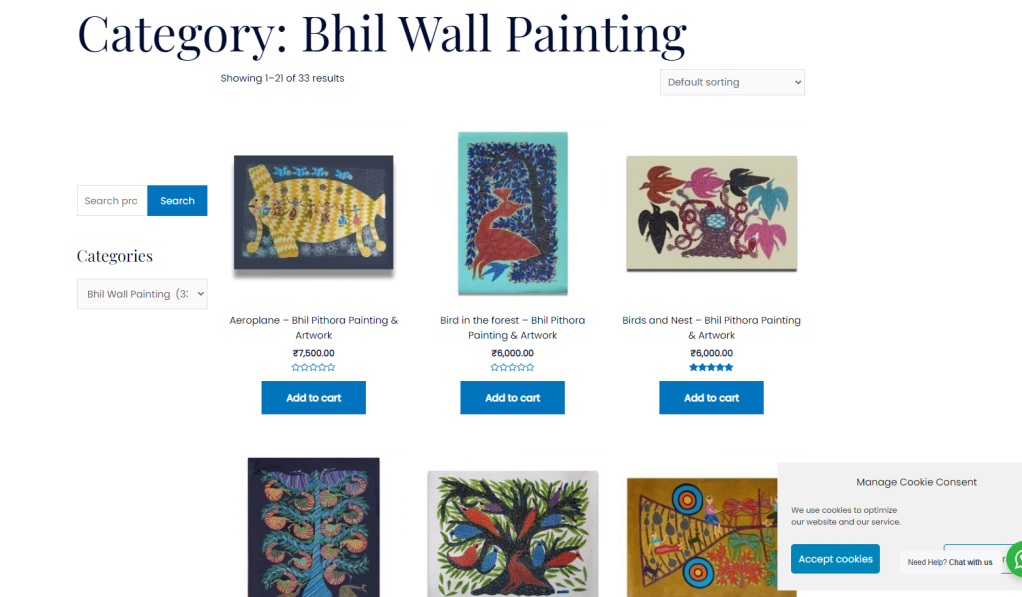
Practitioners of Bhil painting forms the second largest community of India residing in the state of Madhya Pradesh, Gujrat , Rajasthan and Maharashtra. Bhil painting is characterised by the use of multi-coloured dots as in-filling . Some of the famous names representing these paintings are: Bhuri Bai being the first Bhil artist to paint using readymade colours and paper. Other known Bhil artists include , Lado bhai , Sher Singh, Ram Singh and Dubu Bariya. The themes of Bhil Art is born out of an ancient connection with nature. Legends and lore occupy major part in the Bhil
paintings. Images would be painted with neem sticks and other twigs, and natural dyes would be used. Turmeric, flour, vegetables, leaves and oil were used to derive brilliant colours. Bhil paintings usually consist of large, un-lifelike shapes of everyday characters filled in with earthy, yet bright colours, and then covered with an overlay of uniform
dots in several patterns and colours that stand out strikingly against the background. Significant feature of Bhil art is the use of the dots that are not random. They are patterns that could be made to represent anything that the artists wish to, from ancestors to deities. Very often dot patterns can be counted as the artist’s signature style.
Saora paintings of Orissa:
Saora paintings is drawn by the saora tribe inhabiting the hilly area of the koraput, Gunpur, Ganjam and Gajapati districts of south Orissa. The paintings of the saora community are linked to the healing process for disease, safe childbirth and other life events. The Sun, moon, icons of the tutelary spirits, and ghosts, form the contents of the paintings. Now a days contemporary motifs such as bicycles, motor car and airplanes are also used. These paintings are done on wall
surfaces smeared with red ochre and rice paste. Yellow, ultramarine blue and black are also used at times to enhance the visual effect. No adhesive is added to fix the colors on the wall. Palm twigs are used as brushes for painting, the end of the stick being beaten by the painter to make it fibrous.
Pithoro paintings of Gujarat:
Pithora is a highly ritualistic painting done on the walls by several tribes such as the Rathwas and Bhilalas who live
in the central Gujarat, in a village of Vadodara called Tejgadh. The Pithora is a folk art form originating from an ancient ritualistic tradition of mural paintings initiated within tribal beliefs and customs.
Pithora Dev is their principal
deity that features in these paintings .
India has one of the oldest oral traditions in the world owing to the Subcontinent’s long history of civilization. As a result, several oral stories that are collectively called ‘folktales’, have been passed down through centuries to the current generation. These folktales include Epics, fables, mythological stories, stories praising Kings and glorified stories of local heroes represented in the form of books, poetry, music, dance, bhakti hymns, drama, traditional and folk art, etc. These ‘Indian’ folktales travelled through regions and cultures within India for thousands of years, circulating and adapting into our collective cultural identity as an Indian.
Although these stories were spread from one region to another orally- through saints and poets, the representation of these stories in the Indian traditional and Folk Art has kept the stories alive even today. Historians trace these stories back to more than 2500 years ago as there are many pieces of evidence left of these stories in the temple carvings, sculptures, frescos, and books. The most popular of the Indian Folktales are the epics Ramayana and Mahabharata, Indian Mythological stories of Lord Shiva and Lord Vishnu and their many avatars, Jataka Tales, Panchatantra, Hitopadesha and more recently Amar Chitra Katha. These stories have given us various interpretations and adaptations and remain a significant part of our collective identity.
It is was during the British rule that proper research had surfaced for Indian folklore in an attempt to better understand the Indian value system for administrative reasons. A group of Christian missionaries at the time also sought to learn Indian folklore so they could create religious literature for evangelistic purposes. After Independence in 1947, Indian scholars and academicians began to search for their national and local identities through legends, myths, and epics. By the 1970s, Academic institutions and universities in India had established departments to study the folklore of their respective regions, particularly in south India, to preserve their cultural identity and languages. Since 1990, a number of epics have been collected and translated into English, with critical notes and introductions. Today, we have comic books, cartoons, television drama and even movies based on the epics and local stories in the mainstream culture. The Indian folklore is also studied in schools as part of moral teachings and represented in school plays and dances.
With half of the Indian identity consumed in the Indian folklore, it is not surprising to see these stories being represented in the Indian Folk, Modern and Contemporary Art. By definition, Indian Folk Art predates Indian Modern Art and therefore becomes a fascinating study of the representation of the folklores by different cultures within India. Madhubani paintings, Tanjore Paintings, Rajput Paintings, Pattachitra, Kalamkari, Kalighat Paintings, Warli Art, and many more, are examples of Folk Art that depict mythological stories and ritualistic motifs. During the early 1900s, when Indian artists formed groups to promote Indianness, many of the Folk-Art techniques and subjects appealed to them. It wasn’t long before folklore translated its way to Indian Modern Art as well.
-
Tribal Art
Madhubani artwork: a dive into an indian folk art shape
madhubani art: a dive into an indian folk art form
art is an expression that makes use of the cultural symbols. The archive of the collective reminiscences of a tradition is seemed to be drawing, sculpture, poetry, literature and different media. Art keeps what fact-based totally historic documents do no longer: how it felt at a positive time to stay in a selected length. Madhubani is one such artwork shape we are going to talk approximately in these days’s weblog. Majorly practised with the aid of the humans of nepal and bihar (a north-japanese state of india), is now one of the maximum popular artwork paperwork. Tribal Art The madhubani paintings are also called art of mithila because this style of painting originated from an area referred to as mithila (in bihar, india currently). What is madhubani art? Madhubani paintings are a sort of folk-art form. The portray of madhubani is represented by using line drawings filled with bright colorations and contrasts or styles. Using natural dyes and pigments, this drawing is completed with some of materials, which includes fingertips, twigs, brushes, nib-pens, and matchsticks. It is categorised with the aid of its alluring geometric styles. The madhubani art work include ritual content material which include marriage or start and fairs. Due to their tribal motifs and use of shiny earthy colours, madhubani art work are famous and may be easily recognized. The drawings are achieved with the artists’ formulated mineral pigments. Preferably, madhubani art is achieved on a newly plastered wall or a dust wall. The work is now being executed on paper, fabric, canvas and many others for commercial functions. History of madhubani art form:
the history of madhubani paintings is said thus far lower back to the time of ramayana which is set 2500 years in the past. King janaka, ruler of mithila kingdom within the 8th or 7th century bce, requested an artist to represent the marriage of his daughter, sita, to prince rama. And in view that then, on every occasion any house of mithila celebrated a happy event, humans drew madhubani art work on the partitions of their homes. The paintings are the painters’ sole monopoly and their interpretation has been transferred from down the generations, from moms to daughters. Girls analyze from adolescence to play with a broom and with paints. The very last second is the decoration of the kohbar, the room of the residence wherein, after their wedding, the brand new couple stays. Traditionally, the girls of the area have achieved this type of painting, but these days men also are collaborating to fulfill the demand.
-
The Gonds and Bhils are two major tribal communities of Central India, The Bhil tribe is largely found
This Mela was a boost for his career in painting. He also participated in mela Shantiniketan. He is a recipient of West Bengal State Award for Kalighat painting.
MATA NI PACHEDI- JAGDISH CHITARA
Jagdish Chitara, the 48-year-old artist belongs to a traditional nomadic group of artisans known as Waghari. The Waghari people are poor and marginalised community. They would moved around the banks of the Sabarmati River in Gujarat, and made a ritual fabric for the Mother Goddess called Mata Ni Pachedi – the fabric of the mother– this fabric was washed in the river waters, Bhil painting and painted, then painstakingly dyed with natural pigments. The beautiful swathes of cloth were used not only as offerings but also draped to form a temporary shrine for the Goddess.
Although the Waghari’s way of life has changed today – many of them, like Jagdish, now live in towns and cities- they still create the traditional sacred cloth.The colours used are blood red (alizarin)black (ferrous black)and white.The ritual function of the Mata Ni Pachedi continues to exist. Jagdish, who learnt his ancestral craft from his father, strings up his textile art for sale on a pavement in the city of Ahmedabad, where he lives. He has participated in many exhibitions held all over India.
-
Bhil painting
art focus – half empty or half full – a. ramachandran
Posted on August 3, 2020 22
Is the cup half empty, or half full?
This was the one thought which kept flashing through my mind the day I came face-to-face with A. Ramachandran’s art.
One of India’s leading contemporary artists, when Ramachandran [b. 1935], a native of the South Indian state of Kerala and alumnus of Santiniketan started painting, the world he saw around him was a sad, painful one filled with conflict and anguish. It was post-1947 and India was reeling from the aftermath of the partition whilst the world at large still carried the wounds of World War II. Continue reading →
SHARE THIS:
Click to share on WhatsApp (Opens in new window)Click to share on Twitter (Opens in new window)Click to share on Pinterest (Opens in new window)Click to share on Facebook (Opens in new window)Click to share on LinkedIn (Opens in new window)Click to share on Reddit (Opens in new window)Click to print (Opens in new window)Click to email this to a friend (Opens in new window)Click to share on Tumblr (Opens in new window)Click to share on Pocket (Opens in new window)Click to share on Telegram (Opens in new window)Click to share on Skype (Opens in new window)
Posted in Art and Me | Tagged 1947, A Ramachandran, Anti-Sikh Riots, Bhil Tribe, Indian Contemporary Art, Paintings, Partition | 22 Replies
photo essay: in search of bundi’s prehistoric rock paintings Posted on September 8, 2017
32 Destination, or the journey? In travel, it is often hard put to distinguish between the two.
When I went to Bundi in Rajasthan a fortnight ago, I had no clue that merely 30 kilometres south of the town were 101 sites of prehistoric rock art painted 15,000 years ago. They were discovered by a one Mr. Kukkiji in gond painting 1997, who was to take me to the sites himself. What I knew less of was the charms of the paintings’ backdrop—the caves lined tranquil wide rivers, on whose lush shores the Bhil, an Indian Adivasi tribal had made their homes. Continue reading →
SHARE THIS:
Click to share on WhatsApp (Opens in new window)Click to share on Twitter (Opens in new window)Click to share on Pinterest (Opens in new window)Click to share on Facebook (Opens in new window)Click to share on LinkedIn (Opens in new window)Click to share on Reddit (Opens in new window)Click to print (Opens in new window)Click to email this to a friend (Opens in new window)Click to share on Tumblr (Opens in new window)Click to share on Pocket (Opens in new window)Click to share on Telegram (Opens in new window)Click to share on Skype (Opens in new window)
Posted in Exploring India, Rajasthan | Tagged Adventure Travel, Bhil Tribe, Gararda, Kukkiji, Mesolithic Period in India, Prehistoric Art, Rabari Herders, Rajasthan, Rajasthan Tourism, Rock Paintings, Things to do in Bundi | 32 Replies
global travel shot: the prehistoric rock paintings of bundi
IMAGE
14
The image above is that of an antelope in a forest, next to a trap waiting to catapult it to its death. Nope. This is not somewhere in the interiors of France or Spain, more commonly associated with prehistoric art, or even in Bhimbetka where India’s prized rock art collection lies.
It is instead on the insides of a cave lining a tributary of the river Chambal in Gararda, Rajasthan, 35 kilometres from Bundi, my base a fortnight ago.
Painted 15,000 years ago in mineral colours, very few people know of it. Just a handful come from the far corners of the world to marvel at its beauty, and timelessness.
And if it were not for a local sweetmeat-shop-owner-turned-archaeologist, we would not know of it either. He discovered the site in 1997 and has passionately been creating awareness of it ever since, unearthing 101 caves festooned with prehistoric art to-date. His name is Kukkiji
-
gond painting
About Gond Painting
Gond painting is a famous folk art of the Gond tribal community of central India. It is done to preserve and communicate the culture gond painting of the Gond tribal community. Gond tribal art includes folk dances, folk songs, and Gond paintings.
The present-day Gond paintings have evolved from Digna and Bhittichitra.
The Gonds paint Digna, a traditional geometric pattern on the walls and floors of the houses.
Bhittichitra is painted on the walls of houses, and these paintings include images of animals, plants, and trees.
Women use natural colors to paint the walls and floors of their homes.
Gond Tribe
The Gond tribe is one of the largest tribal communities in India. These tribals live in Madhya Pradesh, Telangana, Bihar, Maharashtra, Odisha, and Andhra Pradesh. The main occupation of the Gond tribe is agriculture or daily wages.
The word Gond comes from ‘Kond’ which means green mountains and tribal people are called Gondis as they live mainly in the lush green mountains of Madhya Pradesh.
The Gond tribe believes that seeing a good image brings lots of good luck to them. Hence Gond tribal paintings are made on various festivals, rituals, and ceremonies such as Diwali, Karva Chauth, Nag Panchami, birth, marriage, etc.
Gond Painting of Three Stags
Gond Painting of Three Stags
Traditional Art of the State of Madhya Pradesh, India
Gond painting is a traditional art of Madhya Pradesh and belongs to the Gond tribe. It is mainly done in Patangarh Village in Dindori district of Madhya Pradesh.
-
Bhil painting
(Bhil painting by renowned Bhil artist Ladoo Bai)
Today, we’re getting to see much more of Bhil art in the mainstream. Clay has been replaced by canvas, natural dyes with acrylic paints. The artists who would earlier paint on walls and floors of their village homes, are now Bhil painting recognized over the country and even internationally, their works sold for hundreds of dollars. But there’s something about this form of art that is so rooted, that a change in medium or even recognition, does not rid it of the honesty of its depictions.
(Bhil painting be Dubu Bariya)
Recognition and Change
One can find authentic Bhil art adorning the walls of the anthropology museum, Museum of Man, in Bhopal, Madhya Pradesh. This is the work of Bhuri Bai of Jher, one of the most well known Bhil artists of our time. Other contemporary Bhil artists to note are Ladoo Bai, Sher Singh, whose work is characterized by his distinctive colour palette of red, green and black, Ram Singh and Dubu Bariya.
(Bhuri Bai of Jher)
In recent times, Bhil artists have started including modern elements into their cast of characters. Buses and other transport are frequent themes. This is a perfect example of the truthfulness of the art form, that records life as it is, as it progresses. It is this honest simplicity that makes Bhil art so striking. There is something almost sacred in the dots that fill up the less than perfect shapes, telling us a story about life as it happens.
-
Subscribe
Subscribed
Have a WordPress.com account? Log in now.

